

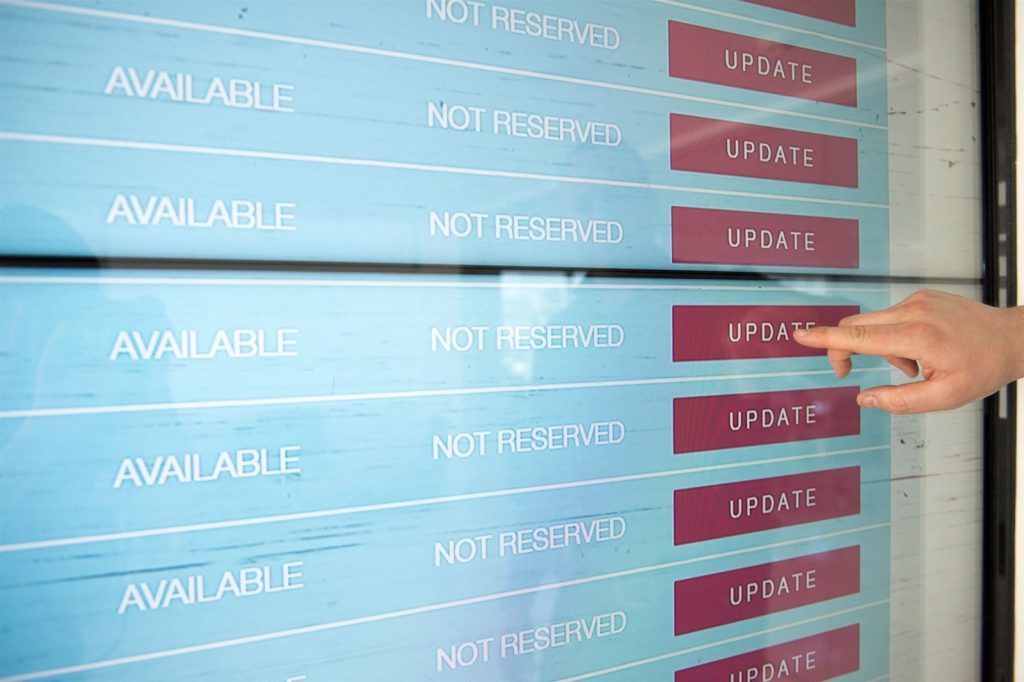
When your website was built, someone wrote code to make it work. Every time you want to change a phone number, add a new service, or publish a blog post, you do not want to touch that code. A content management system, or CMS, is the software layer that sits between you and the code so you can make changes through a regular interface, the same way you edit a document.
Without a CMS, updating your website requires either a developer or technical knowledge you may not have. With one, you log in, click where you want to make a change, type the new content, and hit save.
How a CMS works
Think of a CMS as a filing cabinet for your website. The design, fonts, colors, and layout are stored in one drawer. The content, words, images, and pages, is stored in another. When someone visits your site, the CMS combines the two and shows the result in their browser.
Because the content is separate from the design, you can change a blog post without accidentally breaking your navigation menu. You can add a new service page without touching the homepage. This separation is what makes a CMS so practical for a busy Jamaican business owner who wants to maintain their own website without constant developer help.
Wikipedia’s entry on content management systems gives a good technical overview if you want to understand the architecture in more depth.
The main options for Jamaican businesses
WordPress powers roughly 43% of all websites on the internet as of 2026. It is open source, free to install, and runs on your own hosting. It has the largest ecosystem of themes and plugins of any platform. It is what the team at SitePact JA builds on almost exclusively because of its flexibility, the richness of the WooCommerce integration for e-commerce, and the fact that you fully own your site.

Wix is a hosted platform with a drag-and-drop builder. It is easy to use for beginners. The drawback is that once you build on Wix, you cannot export your design to a different platform. You are locked in. It also has limitations around SEO and e-commerce that become frustrating as a business grows. Wix’s support centre documents what the platform can and cannot do.
Squarespace is known for beautiful design templates and is popular with creative professionals, photographers, and restaurants. Its e-commerce functionality is limited compared to WooCommerce, and like Wix, it is a closed platform. It works well for straightforward portfolio or service sites that do not need heavy customization.
Shopify is technically a CMS, but built specifically for e-commerce. It is covered in more depth in our WooCommerce vs Shopify comparison for Jamaican businesses.
What to look for when choosing a CMS
Data ownership matters more than most people realize. On a platform like Wix or Squarespace, your content lives on their servers and their platform. If they shut down, change their pricing, or you want to move, extraction is painful. On WordPress with your own hosting, you own your files and database completely.
SEO capability varies widely. WordPress with a plugin like Rank Math or Yoast gives you full control over meta titles, descriptions, schema markup, and technical SEO settings. Wix and Squarespace have improved their SEO features but still trail behind what is possible on WordPress.
E-commerce readiness is worth thinking about even if you are not selling online now. If there is any chance you will add products or online booking in the future, starting on a platform that supports it well saves a painful migration later.
Ease of updating is important if you are managing your own content. All the platforms above have reasonable interfaces for daily updates. WordPress has a steeper initial learning curve but becomes fast and easy once you are familiar with it.
The honest recommendation
For most Jamaican small businesses, WordPress is the right choice. It is free, flexible, self-hosted, and has the best long-term track record of any CMS. The learning curve is real but manageable, and you can always hire someone for the parts you find difficult.

For a very small business, a one-person operation, or a creative professional who wants a simple, beautiful site and does not need e-commerce or heavy customization, Squarespace is worth considering.
We help Jamaican businesses get the most from WordPress through our web design services and ongoing maintenance plans.
Frequently asked questions
Does a Jamaican small business need a CMS?
Yes, in almost every case. Without a CMS, you need a developer to make even simple changes to your website, like updating your business hours or adding a new service. A CMS lets you manage your own content through a standard interface without touching code, which saves you time and money.
Is WordPress free to use in Jamaica?
WordPress software is free to download and install. You pay separately for web hosting (typically USD 10 to USD 30 per month for a small business site) and a domain name (around USD 15 to USD 20 per year). Premium themes and plugins have their own costs but are optional. The core WordPress system itself costs nothing.
What is the difference between WordPress.com and WordPress.org?
WordPress.org is the free, open-source software you install on your own hosting. WordPress.com is a hosted service by Automattic that uses the same software but manages the hosting for you, with restrictions on customization at the lower plan levels. For a Jamaican business that wants full control, WordPress.org on your own hosting is the right choice.
Can I switch from Wix or Squarespace to WordPress?
Yes, but it is not a simple export-and-import process. Content (blog posts, pages, images) can usually be migrated, but the design must be rebuilt from scratch on WordPress. It is a proper migration project, typically taking one to two weeks depending on the size of the site. The investment is worth it if you are ready to grow beyond the limitations of a hosted builder.
Can I update a CMS-based Jamaican business website myself without a developer?
Yes, and this is one of the main reasons most Jamaican businesses choose a CMS. WordPress, Wix, and Squarespace are designed for non-technical users to update text, add blog posts, swap images, and manage products without writing code. Most Jamaican business owners can handle day-to-day content updates after a brief initial orientation with their web developer.
